Address pattern tools
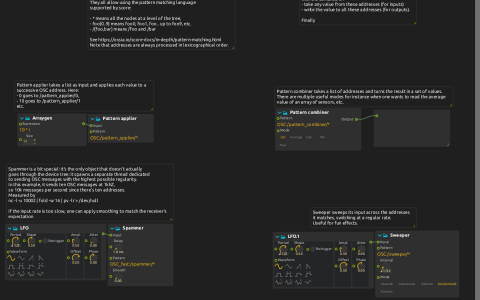
Compare distributing, collecting, sweeping and regularly transmitting values across address patterns.
Run the four branches
Start playback and inspect the OSC device trees. Arraygen creates ten values with 10 * i; Pattern applier distributes them to the matching OSC:/pattern_applier/* nodes. Matches use lexicographical order, not numeric order: names such as 10 sort before 2. Check the actual node names before assuming list indices match numeric suffixes.
Pattern combiner gathers OSC:/pattern_combiner/* in List mode and sends the result to Value display. Change values on those nodes to observe the collected list. The Sweeper branch distributes its LFO input over OSC:/sweeper/* in RandomWalk mode; change its interval or mode to compare traversal patterns.
The remaining LFO feeds Spammer, targeting OSC_fast:/spammer/* with a saved delay of approximately 0.994 ms. Spammer sends OSC on its own thread rather than updating the device tree; inspect an OSC receiver to see this branch. Its high message rate is intentional, so do not aim it at an unprepared network endpoint.
Network settings
The ordinary OSC device listens on UDP 9997 and sends to 127.0.0.1:9996. OSC_fast listens on 10001 and sends to 127.0.0.1:10002; use a receiver on 10002 for the fast stream. The saved fast namespace contains /spammer/0 through /spammer/10, so the wildcard matches eleven addresses, despite the patch’s explanatory text referring to ten.
No external files are needed. See pattern matching for alternatives such as foo{0..9} and /{foo,bar}.