LFO
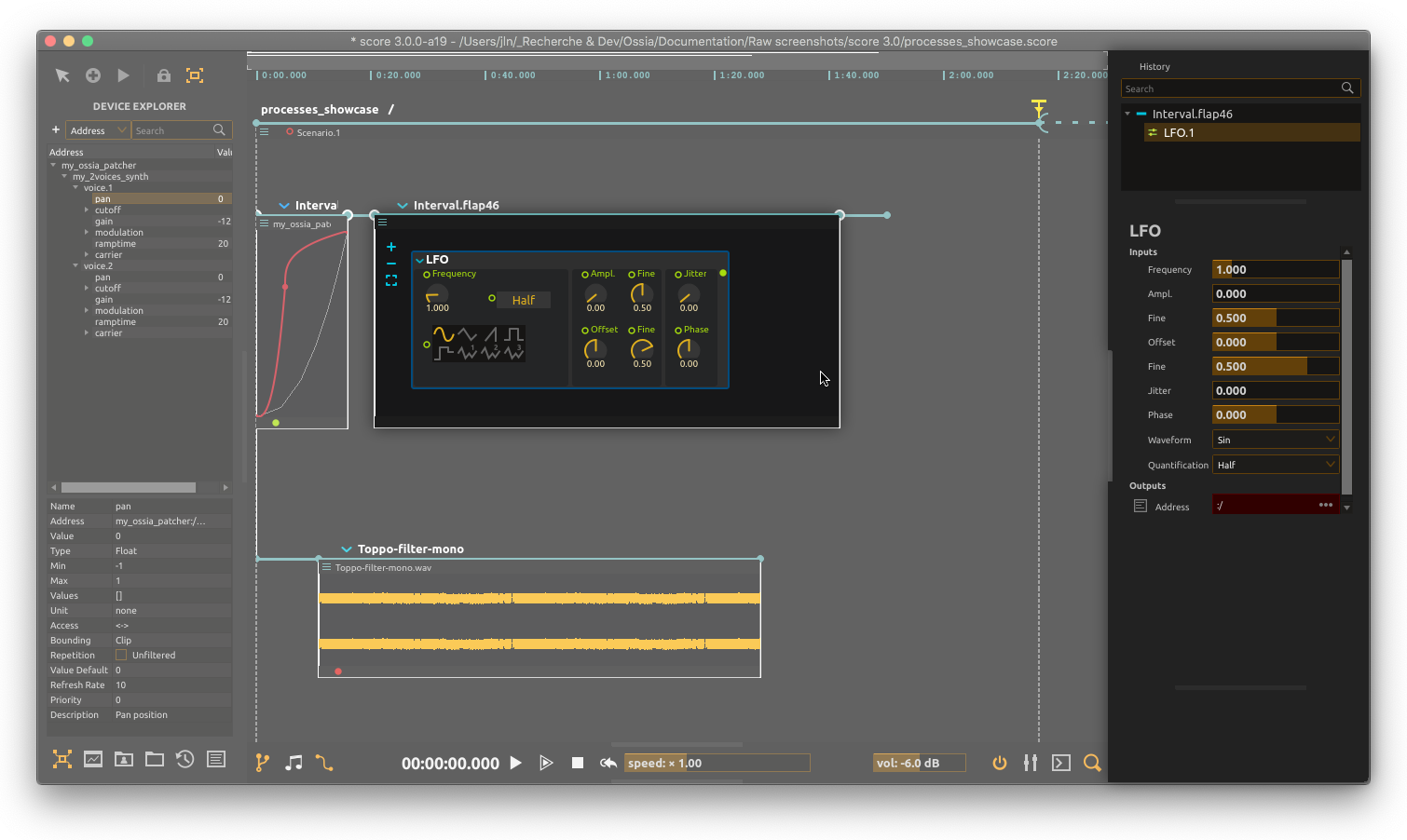
The LFO generates a control value at its Out port: connect it to a parameter to make that parameter oscillate. It does not generate an audio signal.
This page describes LFO version 3. Older scores may contain LFO (old) or LFO (v2), which retain their own controls rather than automatically becoming v3.
Period and synchronization
Period is the duration of one cycle, not its frequency: free range 0.01–60 seconds, default 1 second. A one-second period corresponds to 1 Hz; a two-second period to 0.5 Hz.
Use the time chooser readout to select straight, dotted or triplet note values. Lock to bars affects synchronized mode only:
- Off: cycles accumulate from the playback start or the last Retrigger.
- On: cycles are calculated from the timeline’s musical position, keeping their alignment through tempo changes, jumps and loops. Retrigger establishes a new origin at the current musical position.
Retrigger restarts the cycle; Phase still applies to its starting position. Musical periods are whole-note fractions: a 1/1 cycle is four quarter notes, not necessarily one bar in a different time signature.
Waveform and shape
The waveform selector offers sine, triangle, rising saw, falling ramp, square, sample-and-hold, three noise variants and drift. Square and sample-and-hold each have an every-tick and an on-change variant. Choose on-change when a downstream process should receive only the steps, rather than repeated copies of the held value. Sample-and-hold chooses a new random value at each of the cycle’s two steps.
Shape ranges from 0 to 1 (default 0.5). It changes the rise/fall balance of sine and triangle, the step width of square and sample-and-hold, the curve of the ramps, and the roughness of drift.
Output range and phase
| Control | Range; default | Meaning |
|---|---|---|
| Ampl. | 0–2; 0.5 | Multiplies the waveform, whose base range is −1 to 1. |
| Offset | −1–1; 0.5 | Added after amplitude scaling. |
| Phase | 0–360 degrees; 0 | Constant phase offset. 0 and 360 represent the same point; values outside the range wrap. |
| Jitter | 0–180 degrees; 0 | Adds a random phase offset within ±this amount on each execution tick. This is phase variation, not output-amplitude noise. |
The default amplitude and offset produce values from 0 to 1. For a bipolar modulation around zero, set Offset to 0. The destination’s own range still determines which values are useful.
Older saved LFOs
The earlier variants remain separately registered for saved scores and are marked deprecated. Their frequency-based timing and phase controls must not be interpreted using the v3 units above. To use the new Period, Shape or Lock to bars controls, add a current LFO and deliberately re-create the desired modulation and connections.