Face tracking to native geometry
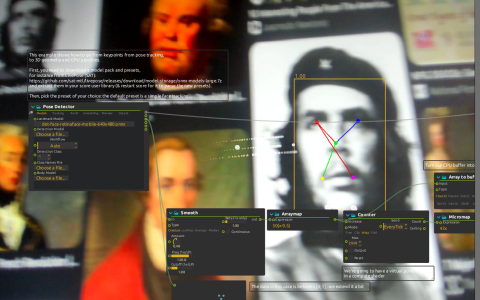
Upload tracked XY coordinates to a GPU buffer and render a particle trail over the camera image.
Setup
Use score with ONNX/Pose Detector support and a compute-capable graphics backend. Install a LivePose model pack in the user library and restart score. The saved Landmark Model is packages/models-presets/models/pose-detector/detectors/det-face-retinaface-mobile-640x480.onnx; update it if your package layout differs. This is face tracking, not a body-pose preset.
The camera device is named Logitech BRIO, saved with Linux /dev/video0, 1280×720 at 30 fps. Select your own camera while retaining the device name, or rebind the detector’s Logitech BRIO:/ input.
Trace the graph
Pose Detector’s Geometry output feeds Point2D View and a OneEuro Smooth filter. Arraymap applies 50(x-0.5) to recenter and enlarge the coordinates. Array to buffer uploads Float32 values for ParticleTrail, whose compute shader writes positions into a circular GPU geometry buffer. SphereSplat renders camera-facing sphere impostors, and Video Mixer combines that image with the annotated camera texture at Window:/.
This is score’s native Compute Shader / Render Pipeline path, not Qt Quick 3D. Adjust startSize, tailColor and SphereSplat’s cameraPos to change the trail’s appearance.
Match the buffer to the detector
The saved patch needs its particle-count settings adapted to the selected model. ParticleTrail is saved with newPointCount=762, while Counter advances writeHead through the Micromap 42x; neither value is derived from the incoming array. The shader reads one XY pair for each new point, so those constants do not match a five-landmark RetinaFace output.
Before relying on the visual result, set newPointCount to the number of XY pairs actually supplied and change the write-head multiplier to the same number (five for one five-keypoint face). maxParticles is 2048; totalWritten is saved at 2048, treating the ring as already full. A different detector or multi-person geometry output needs its own count handling. With coherent buffer counts, moving the detected face supplies new points to the trail rather than reading beyond its input.