Library
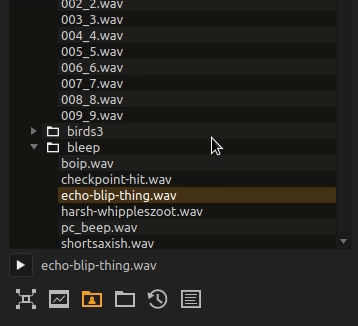
The library is split across multiple panels:
- The Process library: Ctrl+Shift+P(Win / Linux) or⌘+Shift+P(Mac)
- The system library: Ctrl+Shift+B(Win / Linux) or⌘+Shift+B(Mac)
- The project library: Ctrl+Shift+L(Win / Linux) or⌘+Shift+L(Mac)
Process library
This pane shows the processes available to add to the score: automations, audio effects, etc. Everything is there !

The top part shows the list of available processes, grouped by category. Processes there can be dragged to the score.
The middle part shows available presets for the selected processes. Presets can also be dragged to the score.
The bottom part shows information on the selected process.
Categories and preset descriptions
File-backed process entries can be grouped into nested categories derived from their containing folders. Expand the category tree to find related shaders, scripts and other supported library files; the exact entries depend on the installed packages and process plug-ins. Files in a process’s default preset folder can appear directly beneath that process rather than beneath another wrapper.
The preset list remains associated with the selected process. A preset may carry an
optional Description in its .scp JSON metadata; hover over that preset to read it
as a tooltip. A missing description does not prevent a preset from loading.
See Presets for saving and reusing presets.
Package and source updates
When an installed package has an update, the Process library can display a notice with an Update link to the Packages settings page.
This is separate from the inspector’s Update button for a process taken from an external file. For process types that support source refresh, that button appears when the source is out of date and replaces the process with the current file version. It is an undoable edit, not an automatic rewrite of every existing process when a package changes. Review the result before continuing playback.
Fast creation of effect chains
To allow easy experimentation, double-clicking on a process or preset will add it and connect it, if possible, to the currently selected process in the score, or to the currently selected port if a port is selected.
If nothing is selected, the process will be added to the currently displayed interval.
Note: that means that by default, if nothing is selected, the processes may go at the bottom slot and won’t be visible without scrolling to the bottom of the score.
System library
This pane displays content shared across all scores. In a normal installation its
folder is <Documents>/ossia/score/packages. The Library settings change the root
directory above packages.
On first interactive launch, score offers to download the
User Library, containing pre-existing
presets and other content. It is installed in packages/default.
Personal content belongs in packages/user.
Content installed through the package manager also appears here. SDKs and native support packages are stored separately and are not ordinary library items.
The process-library scan is asynchronous, so large packages may take time to appear. Restart if manually copied content is not discovered. A library rescan does not replace running native libraries: restart after installing or changing native support packages.
Various actions are possible:
- Dragging and dropping one or multiple files to the score.
- Double-clicking on files. For instance, double-clicking on a .score will open it.
- Right-click allows to open a folder in the system file explorer.
- Dragging and dropping processes from the score: one can save a preset at a specific place by dragging from the folder preset icon.
Here is an example of saving and loading a whole score as a preset, to embed it recursively in itself.
Important folders in the default library
-
Skins: contains skins which can be changed in the settings. The currently provided screens are adaptations for various color-blindness schemes. -
Util/metro_tick.wavandUtil/metro_tock.wav: replace these if you want to change the sound of the metronome.
Project library
This pane displays the content of the current project folder: this is simply the folder in which the edited score is saved. Otherwise, it behaves exactly like the system library.
Preview
For now, sound files are previewed when clicking on them ; playback can be started and stopped with the little play / stop button at the bottom-left.