Array Value Combiner
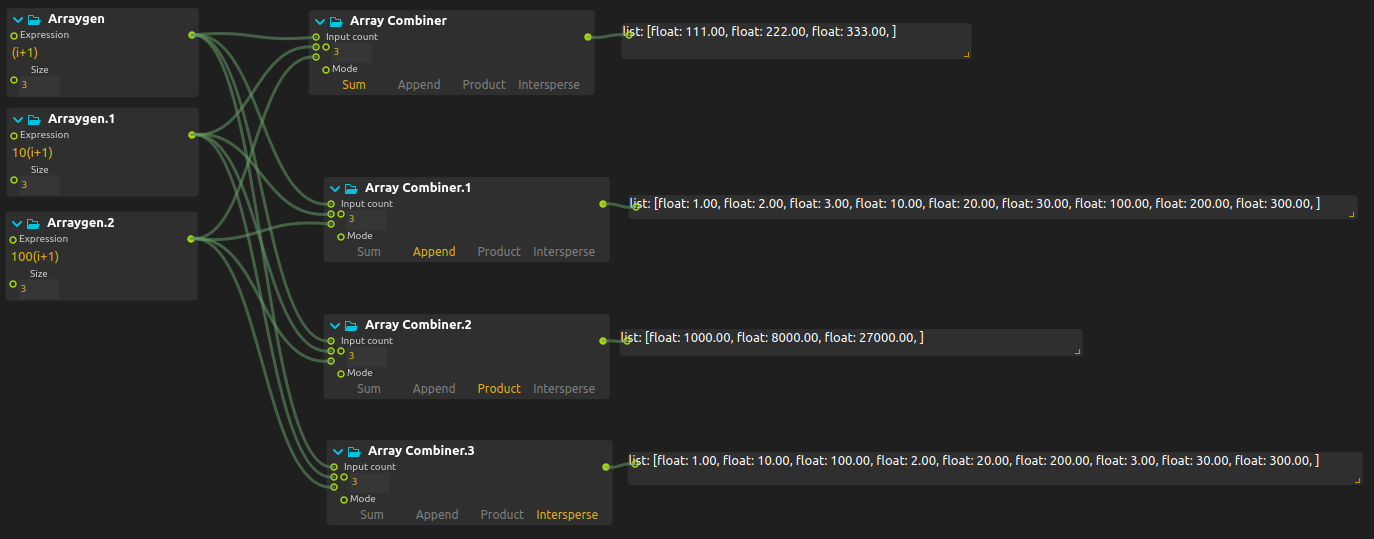
This process combines multiple input arrays in one output array through various modes:
- Sum does an element-wise sum, that is given [1,2] and [10,20] as input the output would be [11, 22].
- Append puts each array behind each other, that is given [1,2] and [10,20] as input the output would be [1, 2, 10, 20].
- Product does an element-wise product, that is given [1,2] and [10,20] as input the output would be [10, 40].
- Intersperse sequences elements in a column-major fashion, that is given [1,2,3] and [10,20,30] as input the output would be [1, 10, 2, 20, 3, 30].
Input count creates the array inputs and Mode selects the operation. Additional element-wise modes are Min, Max, Mean, Subtract, AbsDifference, Divide, Median, and Clamp. Clamp bounds the first input by the second (lower) and third (upper). Missing elements count as zero, except Mean and Median use only inputs containing that element.
CosineSimilarity, DotProduct, EuclideanDistance, and ManhattanDistance compare the first array against each other array over their common length, producing one result per comparison. Connect this result to Array Best Match to select the closest candidate. Greater, Less, GreaterEqual, and LessEqual perform chained element-wise comparisons and return 1 where the relation holds, otherwise 0.
To carry several independent controls in one list and recover them later, open the Combine and Spread Signals walkthrough. An oscillator and an automation curve are combined, then separated into two displayed signals. Change the oscillator frequency and watch which recovered signal changes: list position preserves each control’s identity.
Array tool
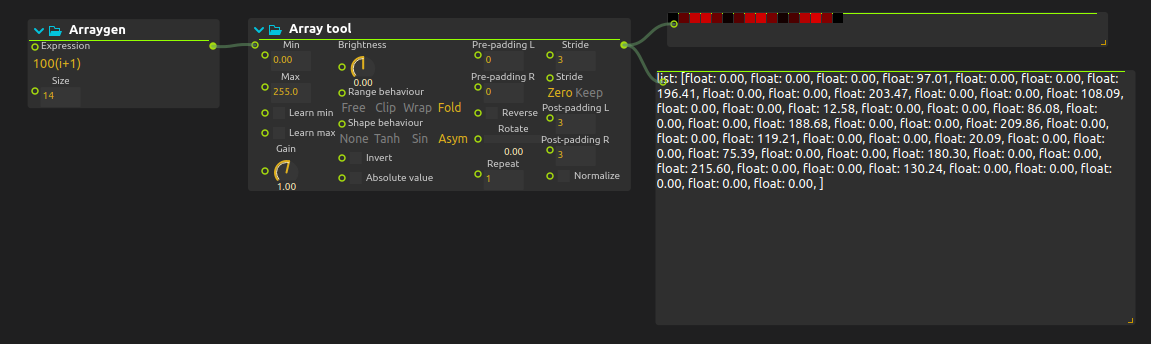
Array tool transforms a numeric array: learn or set its Min/Max, scale with Gain and Brightness, choose range and shape behaviour, invert or take absolute values, and rearrange with padding, Reverse, Rotate, Repeat and Stride. Normalize rescales the result.
Insert Value, From and Every insert a constant at regular output positions, useful for adding an alpha or white channel to pixel data. Every must be greater than 1 to enable insertion. For example, From 3 and Every 4 insert a fourth component after each RGB triple. This differs from Stride, which expands existing values using zeros or repeated values. Erase, its own From, and Every remove regular groups.
Turn a numerical sequence into a visible pixel pattern with the Array Tool LED Reshaping walkthrough. The patch sends the transformed list to both Value display and LED View, so you can relate the numbers to the colors. Change Stride from its saved value of 3 and compare the RGB grouping; no LED hardware is needed.
Array Best Match
Accepts a numeric array on Input and outputs the zero-based Index and Value of its best finite element. Mode: Highest selects a similarity or score; Lowest selects a distance. Probabilities gives a softmax distribution; Softmax scale controls sharpness. Non-finite elements are skipped. New input or a settings change recomputes the result; it does not continuously repeat an unchanged result.
Array Recombiner
Groups a flat list, or the components of a vec2/vec3/vec4, into sublists. Grouping sets group size; a final incomplete group is retained. For [1,2,3,4,5,6], Grouping 2 gives [[1,2],[3,4],[5,6]]. With Transpose, the same input gives [[1,3,5],[2,4,6]], useful for separating interleaved channels.
Enumerator
Retains a List and emits one Value at a time. An impulse on Trigger steps to the next value (the first step is index 0); a number selects an index. Index reports changes to the selected index. Lists and fixed-size vectors are accepted.
Mode is Manual, EveryTick or Timed. Timed uses the Interval time chooser. Bounds chooses Clip, Wrap or Fold when the index passes an end of the list. This is a list walker, not a counter of incoming messages; see Counter in Mapping utilities.
Storage and synchronization
- Buffer queue collects arrivals and can emit a whole buffer or pop one value.
- Tables provide indexed editable storage.
- Rendezvous waits for one fresh value from every inlet.
- LED View visualizes long numerical or pixel arrays.