Math arrays to GPU geometry
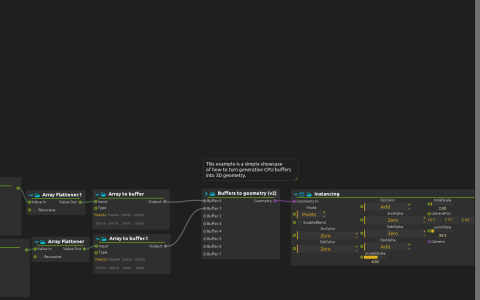
Two Arraygen processes generate 300 entries each. Array Flattener converts their nested position and colour arrays to flat lists, and Array to buffer uploads Float32 buffers. Buffers to geometry binds buffer 0 to position with a 12-byte stride and buffer 1 to color with a 16-byte stride, with 300 vertices.
The native Instancing Render Pipeline renders the geometry. RGB Trails, Multi Pass Gaussian Blur, Exposure Adjust and Glow form a post-processing chain; Video Mixer combines the original trail and processed branches at Window:/. This does not use Qt Quick 3D.
Try it
Start playback and edit the Arraygen expressions to change positions or colours. Keep three floats per position and four per colour, matching the attribute strides; if changing the number of entries, update the geometry vertex count too. Compare the mixer’s branches to separate the generated point pattern from blur and glow.
The score is procedural and does not require external models, images or audio.