Faust Synthesis
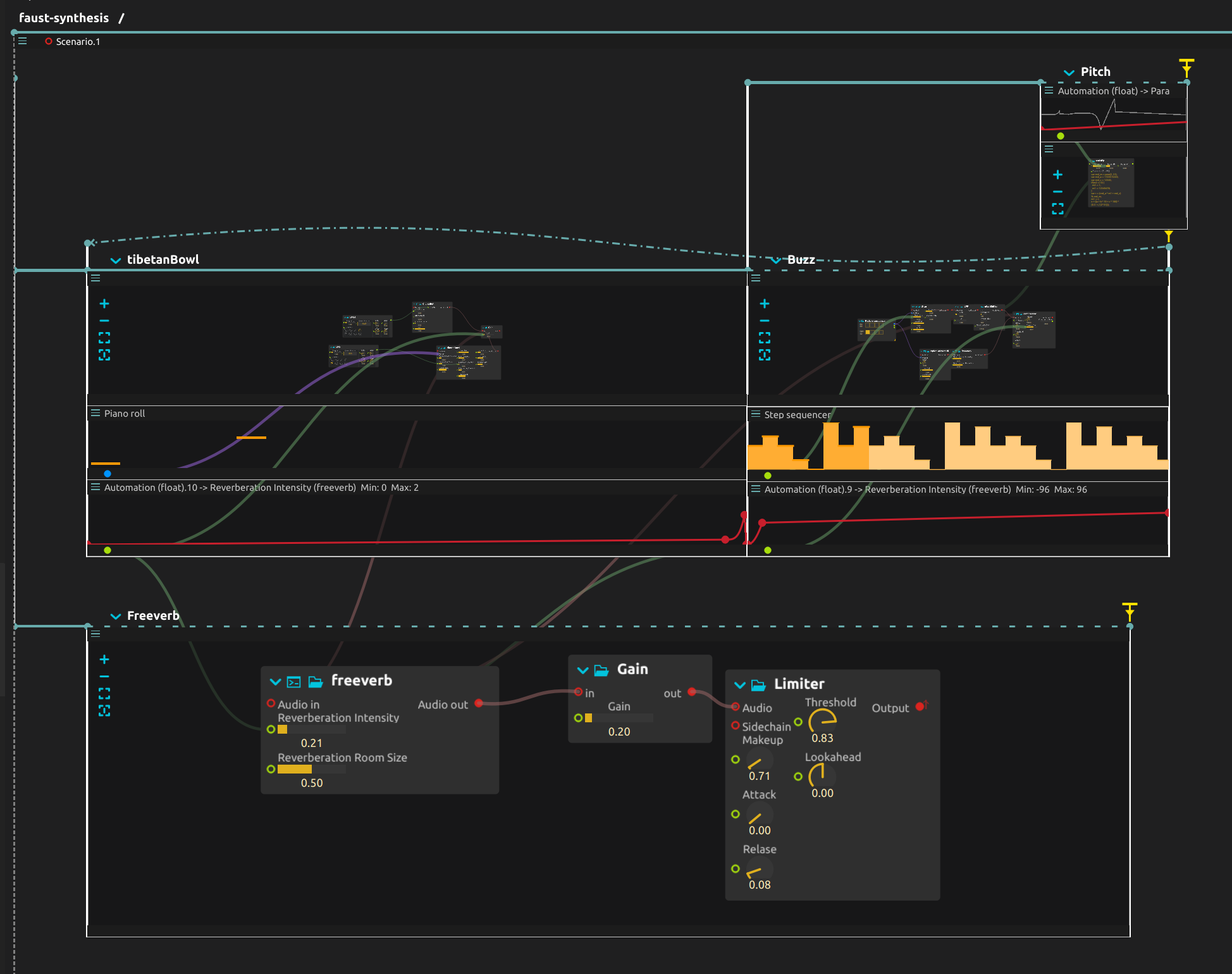
Ringing bells and bowls give way to buzzing, plucked strings in a small synthetic ensemble. The sounds come from physical models, not recordings: changing how a model is excited can alter the character of a strike or pluck as well as its pitch.
Structure
The timeline brings the instruments in and out, while modulation changes their excitation and resonance. Reverb connects the sections, and a later pitch-shifting layer transforms the plucked sounds. The return to the first section is cued by hand, not fixed in time.
The Faust DSP code is embedded, so no samples or MIDI controller are needed. Use a build with Faust support and assign the root interval’s audio output before listening; the saved root has no output destination.
Try it
- Start at a low listening level. Follow the bell and bowl section into
Buzz, where sitar and guitar models take over. Listen for the difference between sustained resonance and the attack of a pluck. - Change the Step sequencer values driving the sitar’s Resonance. This changes the repeating timbral pattern without changing its MIDI notes. The bowl’s excitation is also modulated; adjust its LFO to hear a different pattern of excitation.
- In
Pitch, reshape the automation feedingNoisify. Draw a smooth contour, then one with abrupt steps, and listen to how the pitch-shifted layer moves against the source. - Trigger the end of
Buzzto return to the bowl section. Try holding the plucked section longer before returning: the cue changes the form without rewriting the material. Freeverb and Pitch have independent end triggers; use Stop to finish everything. - Open a Faust process’s script editor to connect the audible controls with its model or effect. Replacing a model is a possible adaptation; the saved score already supplies the timeline and modulation around it.
Learn more
- Audio plugins - Complete guide to VST, VST3, CLAP, LV2, JSFX plugins
- Faust - Writing and using Faust DSP code
- Audio Effects - Built-in audio effect processes
- Supported protocols and formats - All supported audio plugin formats