Cues, loops and exclusive playback
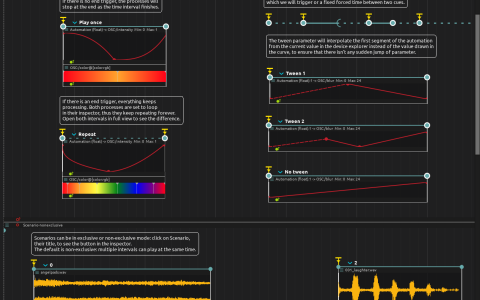
The archive combines three cue demonstrations with a native ISF shader preview. Open the ZIP directly in score.
Parameter cues
ComplexColorPlots feeds Multi Pass Gaussian Blur and Color Monochrome, whose output targets Window:/. Their blur, intensity and color controls read the OSC device tree.
- Start playback and trigger
Send cue 1andSend cue 2. They send different RGB lists toOSC:/color, changing the monochrome tint. - Trigger
Play once: its intensity curve and color gradient finish with their interval. CompareRepeat, whose two processes loop while the interval waits for its interactive end. - Compare the separate intensity cues with the connected cue chain. The former can be triggered independently; the latter must progress in order and includes minimum and maximum interval bounds.
- Set blur to a new value, then compare
Tween 1,Tween 2andNo tween. Tween starts the first segment from the current device value rather than the curve’s drawn start.
The saved OSC device listens on UDP 0.0.0.0:9997 and sends to 127.0.0.1:9996. Its addresses are /width, /blur, /intensity and /color. The shader preview reads the same tree internally, so an external OSC application is optional. This uses score’s native shader pipeline, not Qt Quick 3D.
Audio cue behavior
Open Scenario-nonexclusive and trigger its sound intervals: more than one can run concurrently. Then inspect Scenario-exclusive: starting an interval stops the other intervals in that scenario. Its loop triggers use the root interval’s bar quantization, so a requested switch waits for a musical boundary.
The sound processes reference the bundled Audio/angelpads.wav, Audio/001_laughter.wav, Audio/000_AMEN.WAV and Audio/000_PLEAD.WAV. Configure audio output and listen at a low level; the sound processes feed the parent mix at audio:/out/main.
The annotations also point out the root start and stop states. Inspect these when designing initialization and shutdown cues: ordinary Stop and Stop and reinitialize do not recall the same state.