Heat volume to point cloud
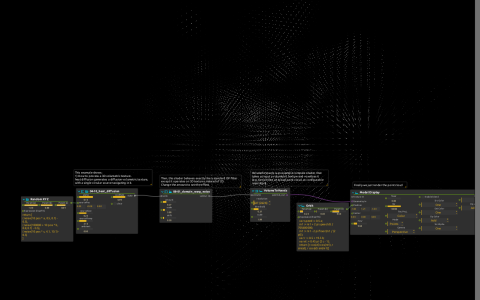
A moving heat source leaves a field that diffuses and cools over time. Sampling that field as points makes the source’s path visible as a trace that lingers and spreads.
The heat simulation writes a three-dimensional texture. Noise warps that texture before VolumeToVoxels samples it into point geometry, which Model Display views from an orbiting camera. The motion of the source, deformation of the field and motion of the viewpoint are separate parts of the image.
Try it
Start playback and bring the warp amount toward zero to see the underlying heat field. Increase it again to distort the form, then vary VolumeToVoxels’ threshold to reveal different parts of the field.
Lower resolution for coarse sampling or raise it for a denser cloud; higher values increase the workload. Use the heat shader’s clear control to reset accumulated state and watch a new trace form. No voxel file is needed, but the simulation and conversion require compute-shader support. The points render with native Model display.