Time Model example
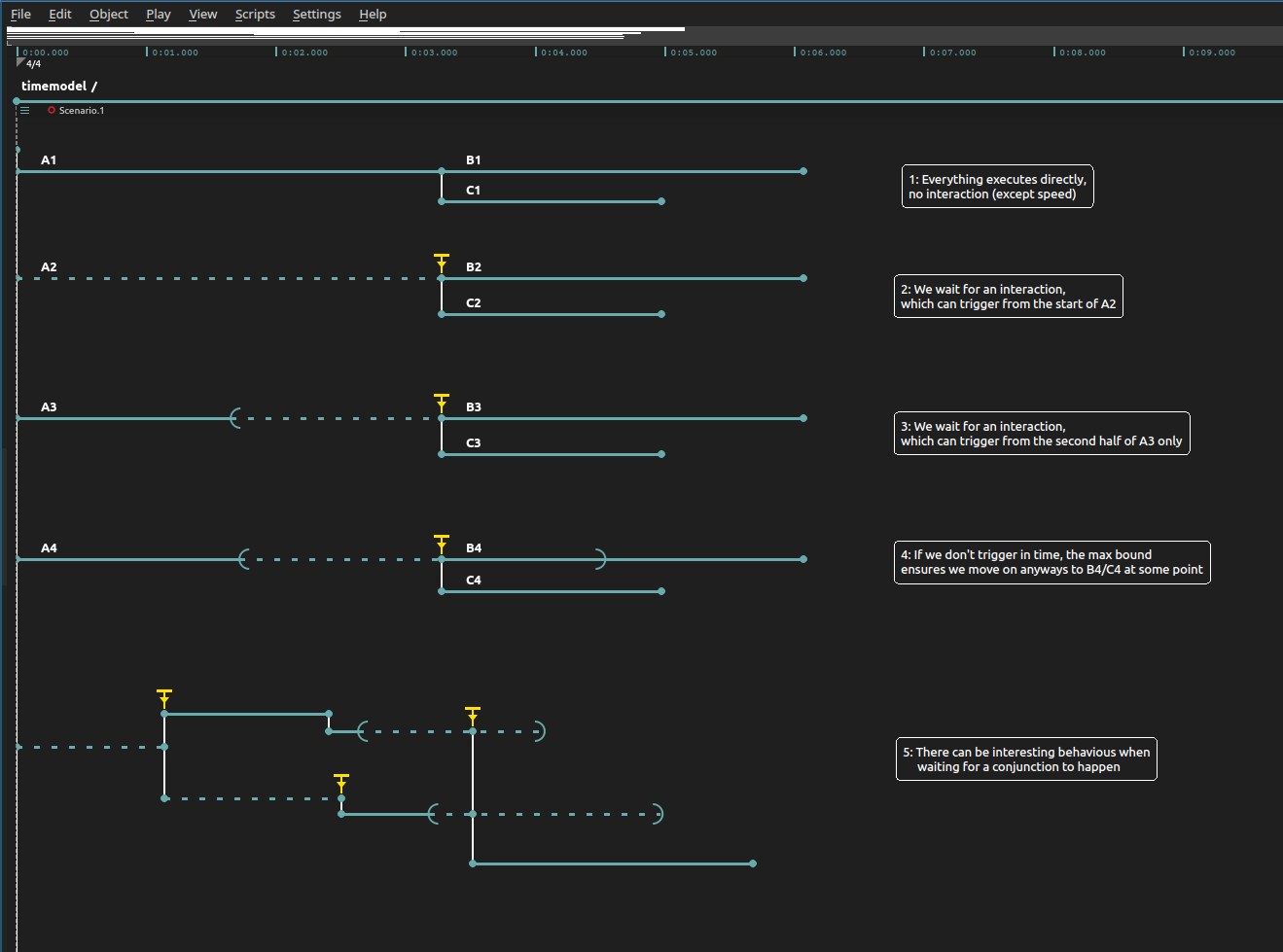
How much freedom should a performer have before the next passage begins? This silent timeline shows an exact duration, an open-ended wait and an interaction with time limits. Watch the active intervals; there is no sound, and no media or external setup is required.
Overview
A minimum duration can keep a passage from being cut short. A maximum can keep an installation from waiting indefinitely. Between those bounds, a trigger gives the performer control of the transition. The next interval starts from the actual transition, not simply the endpoint drawn on the page.
Conditions decide whether a branch participates at all. Shared end points bring parallel activities together, and loops make it possible to revisit a passage.
Try it
- Let A1 run its fixed duration, then let A2 wait and release it yourself: A2 lasts as long as you wait.
- Try A3’s end trigger before and after its minimum duration. Before the minimum, the trigger has no effect.
- Leave A4 without a trigger until its maximum, then restart and end it yourself. The following passage starts at the maximum the first time, and at your trigger the second.
- Change a false condition and replay the branch. Then start and end parallel intervals in different orders, watching the shared end and the loop at the bottom. Separate the question “does this happen?” from “when do we move on?”
For a larger annotated collection with floating triggers and auto-retriggering, see Temporal patterns and synchronization.
Learn more
- Scenario - Timeline container with triggers and conditions
- Execution engine - How interactive execution works
- Non-linear timeline - Building interactive scenarios