Free and open-source (GPLv3) · Windows, macOS, Linux, Raspberry Pi and web browser
ossia score can be used to make generative images and sound: shaders and geometry are connected with cables, code is used where it is more practical, and the result is organized in time as a performance, an installation or a rendered video.
For instance, the Genuary 2022 post presents a month of daily sketches made with score.
Shaders
ISF fragment shaders, compute shaders and raw raster pipelines run in the patch, and the Lygia library can be installed from the package manager (shaders, compute shaders, shader cookbook); a Shadertoy link dropped on score is converted to an ISF shader.
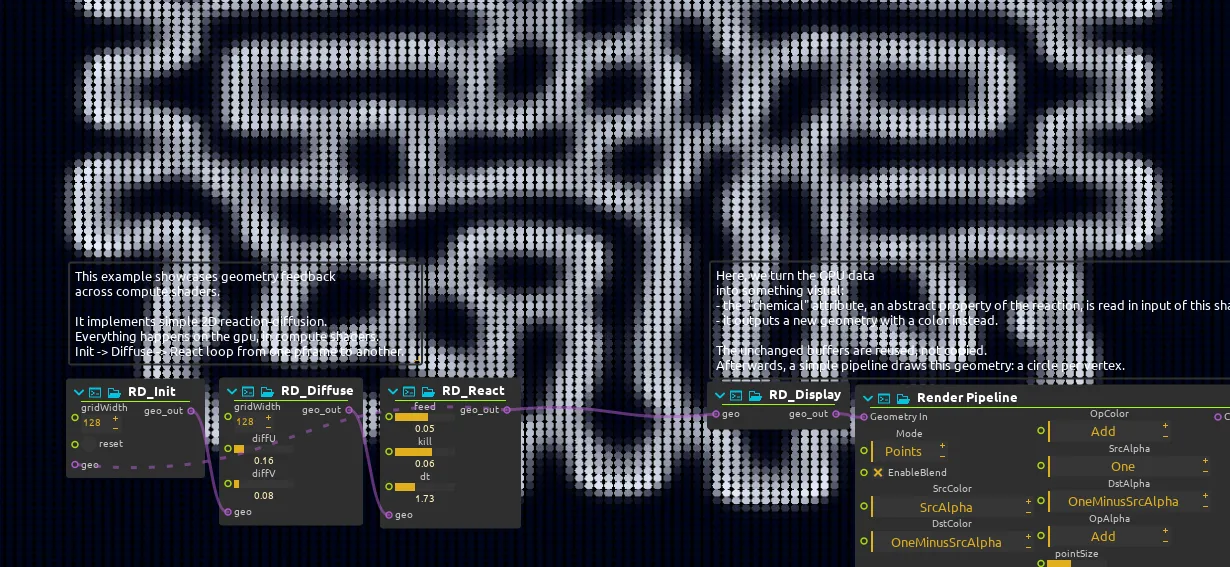
Cables can be delayed and looped back anywhere, which is how reaction-diffusion, trails and other image feedback effects are made (reaction-diffusion).
3D and grammars
The GPU scene pipeline loads glTF, FBX, OBJ, PLY and voxel models, with PBR materials, lights, cameras, instancing, point clouds, volumetric textures and gaussian splats (3D pipeline, gaussian splats, generative 3D).
Context Free Art and Structure Synth generate images and shapes from grammars, and there are also vertex shader art and text-to-mesh objects (Context Free Art, Structure Synth).
Live coding
JavaScript, Faust, shaders, JSFX and C++ compiled on the fly can be edited while the piece is running (live coding).
The sound is part of the same piece, with audio-reactive visuals, Bytebeat, synthesizers and spatial audio (see live music).
Rendering and distribution
A script can render a piece frame by frame to image files, at full quality and independently of real time, for a video, prints or previews; a piece can also be packaged as a standalone application (see custom apps).