Kinetic art and robotics
Write the movements of motors, pumps, robots and mechanisms on a timeline, make them react to sensors, and synchronise them with sound, video and lights, from a computer or a Raspberry Pi. Free and open-source.
Free and open-source (GPLv3) · Windows, macOS, Linux, Raspberry Pi and web browser
Kinetic sculptures, robotic installations and mechanical stage elements need movements that are precise in time, smooth, and often reactive. ossia score treats each motor or actuator as a parameter to automate, next to the sound, video and lights of the piece.
What you can do
- Talk to the hardware: microcontrollers such as Arduino and ESP32 over serial, OSC or MQTT, DMX-controlled motors and effects, and any device with its own protocol through a short script (serial, QML protocols).
- Drive pins directly: GPIO, PWM, ADC and DAC on Linux boards such as the Raspberry Pi and the Orange Pi (raw I/O).
- Write movements: automation curves with musical or absolute timing, LFOs, easing curves and drawn trajectories, looped or varied over time (automations, path generator).
- Keep motion safe for the mechanics: smoothing, rate limiting and range clipping between the score and the motors (smooth, rate limiter).
- React to the world: IMUs, depth cameras, computer vision with blob and point tracking, distance and touch sensors on microcontrollers, tracking systems (sensors to OSC, point tracker).
- Read machine data: receive CAN bus signals through a DBC database on Linux (CAN).
- Sound, video and lights in sync with the mechanics, on one timeline.
- Embedded: run the whole piece headless on a Raspberry Pi (embedded).
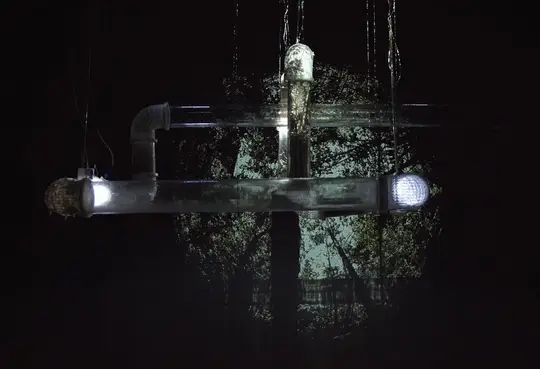
[re]capture, Alice Jarry, Brice Ammar-Khodja, Jacqueline Beaumont, Jean-Michaël Celerier, Matthew Halpenny, Asa Perlman, Philippe Vandal: cameras, video processing, lights, pumps and motors, run entirely by ossia score on a Raspberry Pi. © Alice Jarry
Kinetic art needs, and how ossia score answers them
| What you need | How ossia score does it |
|---|---|
| Movements written precisely in time | Automation curves, trajectories and LFOs on a timeline, with musical or absolute time. |
| Smooth motion that the mechanics can follow | Smoothing, easing and rate limiting before the values reach the motors. |
| Mechanisms that react to visitors or to their own state | Sensors, cameras and machine data feed triggers, conditions and mappings. |
| Motors, sound, video and lights together | One project for all of them, from a single computer. |
| A small, hidden controller | Headless on a Raspberry Pi, talking to microcontrollers in the mechanism. |
See the gallery, for instance [re]capture, and Organism + Excitable Chaos, a pendulum installation awarded the Golden Nica at Prix Ars Electronica 2025, which used ossia for the network communication between the pendulum and the computers.
Free and open-source (GPLv3) · Windows, macOS, Linux, Raspberry Pi and web browser