Interactive dance and theatre
Let movement drive sound, video and light: pose detection from a webcam, depth cameras, motion sensors and tracking systems, with cues and scenes that keep the show reproducible. Free and open-source, on Windows, macOS, Linux and Raspberry Pi.
Free and open-source (GPLv3) · Windows, macOS, Linux, Raspberry Pi and web browser
ossia score is used by dance and theatre companies to connect performers’ movements to the stage: sound, video, light and machinery. The interactive parts live inside a written score, so the show can follow the rehearsed structure and still respond to what happens on stage.
What you can do
- Track bodies with a webcam: multi-person pose detection with smoothing, segmentation, and depth from an ordinary camera (pose detection).
- Depth cameras and tracking systems: Orbbec, Intel RealSense, Kinect, Azure Kinect (Windows and Linux) and Luxonis OAK cameras, from the package manager; PosiStageNet, RTTrP, OpenTrackIO and TUIO (depth cameras, tracking).
- Sensors on the performers: IMUs, Bluetooth LE sensors, Leap Motion, gamepads, Wacom tablets, and anything sending OSC, MIDI or serial data (Bluetooth LE, Leap Motion).
- Understand gestures: gesture analysis, smoothing and filtering, and classifiers or regressors trained from a few recorded movements (gestures, classifier).
- Turn movement into media: positions and gestures drive sound synthesis and spatialisation, shaders, 3D, video and DMX lights, or become MIDI and OSC for other software (tracking to MIDI).
- Keep it a show: scenes, cues and triggers structure the piece, with a GO from the stage manager or from the performers themselves (scenes, cues).
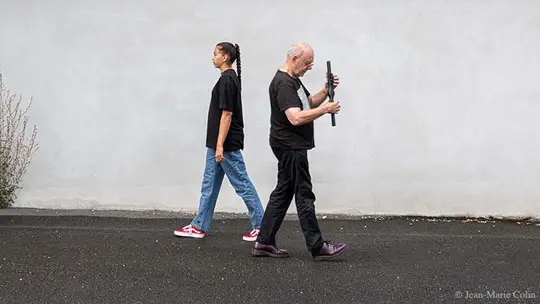
Walking Down The Street, Lina Rahal & Jean-Marie Colin: a hip-hop dance piece whose whole show is driven by ossia score and controlled live with a Karlax. © Jean-Marie Colin
Dance and theatre needs, and how ossia score answers them
| What you need | How ossia score does it |
|---|---|
| Following performers without putting sensors on them | Pose detection from a webcam, depth cameras and tracking systems. |
| Interaction that stays the same from one night to the next | Interactive parts are written inside scenes and cues, with smoothing, calibration and thresholds. |
| Movements that drive sound, video and light together | One project for spatial sound, video, 3D and DMX, all mapped from the same data. |
| Rehearsing and adjusting quickly | Change mappings while the piece runs, and restart from any scene with Play from here. |
| Touring with a light setup | A laptop or a Raspberry Pi, on Windows, macOS or Linux, with media collected into the project. |
See the gallery for dance and theatre pieces made with ossia score, such as Our Bodies Know More Than We Do by Psʌnía, where the performers’ movements drive sound and light.
Free and open-source (GPLv3) · Windows, macOS, Linux, Raspberry Pi and web browser