An output that draws nowhere. More...
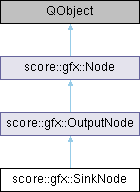
Detailed Description
An output that draws nowhere.
The render graph only runs the nodes that lead to an output, so a node whose result is data (an AI model's Data outlet, an analysis) and whose texture goes nowhere never ran. This output pulls its input into an offscreen target at rate frames per second, and shows nothing.
The render clock ticks at the application's render rate; frames between two due ones are skipped, so the rate can change while playing without rebuilding the clocks. It is capped by the application's rate.
Public Member Functions | |
| SinkNode (double rate) | |
| void | setRate (double fps) noexcept |
| double | rate () const noexcept |
| void | process (Message &&msg) override |
| Process a message from the execution engine. | |
| void | startRendering () override |
| void | render () override |
| bool | canRender () const override |
| void | onRendererChange () override |
| void | stopRendering () override |
| void | setRenderer (std::shared_ptr< RenderList > r) override |
| RenderList * | renderer () const override |
| void | createOutput (OutputConfiguration conf) override |
| void | destroyOutput () override |
| void | updateGraphicsAPI (GraphicsApi api) override |
| std::shared_ptr< RenderState > | renderState () const override |
| TextureRenderTarget | currentRenderTarget () const noexcept override |
| The output's current backing render target + render-pass descriptor, as the upstream nodes should render into it NOW. | |
| OutputNodeRenderer * | createRenderer (RenderList &r) const noexcept override |
| Create a renderer in a given context for this node. | |
| Configuration | configuration () const noexcept override |
| int64_t | frames () const noexcept |
 Public Member Functions inherited from score::gfx::OutputNode Public Member Functions inherited from score::gfx::OutputNode | |
| virtual void | setVSyncCallback (std::function< void()>) |
| Set a callback to drive rendering when there is a single output. | |
| GpuResourceRegistry & | acquireRegistry () |
| Persistent GPU resource registry for this output. | |
| GpuResourceRegistry * | registry () const noexcept |
| Non-owning accessor. Returns null if no registry has been acquired yet (e.g. queried before the first RenderList::init). | |
| void | releaseRegistry () |
| Tear down the registry's QRhi resources directly. Idempotent. | |
| virtual bool | deviceLost () const noexcept |
| True once the output's graphics device was reported lost. | |
| void | handleDeviceLost (const char *output) noexcept |
| Mark the device as lost; logs once per device. | |
| Public Member Functions inherited from score::gfx::Node | |
| Node (const Node &)=delete | |
| Node (Node &&)=delete | |
| Node & | operator= (const Node &)=delete |
| Node & | operator= (Node &&)=delete |
| virtual void | renderedNodesChanged () |
| Whenever render nodes are added / removed. | |
| virtual void | update () |
| void | materialChange () noexcept |
| Used to notify a material change from the model to the renderers. | |
| bool | hasMaterialChanged (int64_t &renderer) const noexcept |
| void | renderTargetChange () noexcept |
| Used to notify a render target (texture inlet) change from the model to the renderers. | |
| bool | hasRenderTargetChanged (int64_t &renderer) const noexcept |
| bool | hasExplicitRenderTargetSize (int32_t port) const noexcept |
| Whether a given port has a user-specified render target size. | |
| bool | hasExplicitRenderTargetSpecs (int32_t port) const noexcept |
| Whether the user set a size or a format on a texture inlet. | |
| QSize | resolveRenderTargetSize (int32_t port, RenderList &renderer) const noexcept |
| RenderTargetSpecs | resolveRenderTargetSpecs (int32_t port, RenderList &renderer) const noexcept |
| std::optional< RenderTargetSpecs > | firstInputRenderTargetSpecs () const noexcept |
| What the first texture input asks to be rendered into. | |
| void | process (int32_t port, const ossia::render_target_spec &v) |
Additional Inherited Members | |
| Public Attributes inherited from score::gfx::Node | |
| std::vector< Port * > | input |
| Input ports of that node. | |
| ossia::small_pod_vector< Port *, 1 > | output |
| Output ports of that node. | |
| ossia::flat_map< RenderList *, score::gfx::NodeRenderer * > | renderedNodes |
| Map associating each RenderList to a Renderer for this model. | |
| ossia::flat_map< int32_t, ossia::render_target_spec > | renderTargetSpecs |
| Render target info. | |
| std::atomic_int64_t | materialChanged {0} |
| std::atomic_int64_t | renderTargetSpecChanged {-1} |
| int32_t | nodeId = score::gfx::invalid_node_index |
| bool | requiresDepth {} |
| Protected Member Functions inherited from score::gfx::OutputNode | |
| bool | checkDeviceLost (const OffscreenFrame &frame, QRhi &rhi, const char *output) noexcept |
| Calls handleDeviceLost when the frame or the QRhi report a lost device. Returns deviceLost(). | |
| bool | checkDeviceLost (int frameOpResult, QRhi &rhi, const char *output) noexcept |
| void | resetDeviceLost () noexcept |
| void | releaseOwnedRenderList () |
| Invoke OutputConfiguration::onReleaseRenderList, if any. | |
| Protected Attributes inherited from score::gfx::OutputNode | |
| std::function< void()> | m_onReleaseRenderList |
| std::unique_ptr< GpuResourceRegistry > | m_registry |
| bool | m_deviceLost {} |
Member Function Documentation
◆ canRender()
|
overridevirtual |
Implements score::gfx::OutputNode.
◆ configuration()
|
overridevirtualnoexcept |
Implements score::gfx::OutputNode.
◆ createOutput()
|
overridevirtual |
Implements score::gfx::OutputNode.
◆ createRenderer()
|
overridevirtualnoexcept |
Create a renderer in a given context for this node.
Implements score::gfx::OutputNode.
◆ currentRenderTarget()
|
overridevirtualnoexcept |
The output's current backing render target + render-pass descriptor, as the upstream nodes should render into it NOW.
A sink whose render target / render-pass descriptor can be recreated mid-session (e.g. an offscreen BackgroundNode on a viewport resize, which deleteLater()s the old target and installs a fresh one) must override this so that a renderer which cached the target by value at construction can re-adopt the live handles when it is rebuilt (RenderList::maybeRebuild or rebuildOutputTargets -> OutputNodeRenderer::init). The default returns an empty target, meaning "nothing to refresh — keep the value captured at createRenderer() time".
Without this, the resize fast-path (resizeSwapchainSizedTargets, which re-inits the output renderer in place instead of reconstructing it) leaves the upstream node's final pass bound to the freed render-pass descriptor — a Vulkan use-after-free of the VkRenderPass.
Reimplemented from score::gfx::OutputNode.
◆ destroyOutput()
|
overridevirtual |
Implements score::gfx::OutputNode.
◆ onRendererChange()
|
overridevirtual |
Implements score::gfx::OutputNode.
◆ process()
|
overridevirtual |
Process a message from the execution engine.
Reimplemented from score::gfx::Node.
◆ render()
|
overridevirtual |
Implements score::gfx::OutputNode.
◆ renderer()
|
overridevirtual |
Implements score::gfx::OutputNode.
◆ renderState()
|
overridevirtual |
Implements score::gfx::OutputNode.
◆ setRenderer()
|
overridevirtual |
Implements score::gfx::OutputNode.
◆ startRendering()
|
overridevirtual |
Implements score::gfx::OutputNode.
◆ stopRendering()
|
overridevirtual |
Implements score::gfx::OutputNode.
◆ updateGraphicsAPI()
|
overridevirtual |
Reimplemented from score::gfx::OutputNode.
The documentation for this class was generated from the following files:
- SinkNode.hpp
- SinkNode.cpp