The pointers of an output as a texture: vertexshaderart's touch history (greggman/vertexshaderart, src/js/main.js).
More...
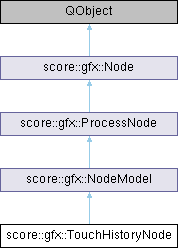
Detailed Description
The pointers of an output as a texture: vertexshaderart's touch history (greggman/vertexshaderart, src/js/main.js).
32 columns, one per pointer slot of PointerState (0 = the mouse or the first finger), 240 rows, one per rendered frame: texel (x, y, pressure, time), x and y in clip space, y up. The newest row is the bottom of the image – v = 0 of IMG_NORM_PIXEL in an ISF and of texture() in a VSA, on every backend – and the top one is 239 frames old, as in WebGL where row 0 is v = 0 (main.js HistoryTexture / CPUHistoryTexture).
The window devices publish it as the texture address touch/history, fed from their touch/points address (Gfx/Window/PointerAddresses.hpp): it is an ordinary texture source, read by whatever is bound or cabled to it.
It draws into the render target of the input it feeds; that input should be 32x240 RGBA32F, NEAREST, which is what the default binding of an image input named touch asks for (ISFProcess.hpp). The draw is a straight copy: the target is cleared to zero and the colour is composited as premultiplied, so all four channels land as they are, time in alpha included.
w is the seconds since this node was created, the same clock for every output; on vertexshaderart it is the art's time uniform.
Public Member Functions | |
| TouchHistoryNode (std::shared_ptr< PointerState > pointers) | |
| NodeRenderer * | createRenderer (RenderList &r) const noexcept override |
| Create a renderer in a given context for this node. | |
 Public Member Functions inherited from score::gfx::ProcessNode | |
| void | process (Message &&msg) override |
| Process a message from the execution engine. | |
| virtual void | process (Timings tk) |
| virtual void | process (int32_t port, const ossia::value &v) |
| virtual void | process (int32_t port, const ossia::audio_vector &v) |
| virtual void | process (int32_t port, const ossia::transform3d &v) |
| void | process (int32_t port, ossia::monostate) const noexcept |
| virtual void | process (int32_t port, const FunctionMessage &) |
| virtual void | process (int32_t port, const ossia::buffer_spec &) |
| bool | resetEventPortsAfterFrame () noexcept |
| Node () | |
| Node (const Node &)=delete | |
| Node (Node &&)=delete | |
| virtual void | process (Message &&msg) |
| Process a message from the execution engine. | |
| void | process (int32_t port, const ossia::render_target_spec &v) |
| Public Member Functions inherited from score::gfx::Node | |
| Node (const Node &)=delete | |
| Node (Node &&)=delete | |
| Node & | operator= (const Node &)=delete |
| Node & | operator= (Node &&)=delete |
| virtual void | renderedNodesChanged () |
| Whenever render nodes are added / removed. | |
| virtual void | update () |
| void | materialChange () noexcept |
| Used to notify a material change from the model to the renderers. | |
| bool | hasMaterialChanged (int64_t &renderer) const noexcept |
| void | renderTargetChange () noexcept |
| Used to notify a render target (texture inlet) change from the model to the renderers. | |
| bool | hasRenderTargetChanged (int64_t &renderer) const noexcept |
| bool | hasExplicitRenderTargetSize (int32_t port) const noexcept |
| Whether a given port has a user-specified render target size. | |
| bool | hasExplicitRenderTargetSpecs (int32_t port) const noexcept |
| Whether the user set a size or a format on a texture inlet. | |
| QSize | resolveRenderTargetSize (int32_t port, RenderList &renderer) const noexcept |
| RenderTargetSpecs | resolveRenderTargetSpecs (int32_t port, RenderList &renderer) const noexcept |
| virtual void | adjustRenderTargetSpecs (int32_t port, RenderTargetSpecs &spec) const noexcept |
| std::optional< RenderTargetSpecs > | firstInputRenderTargetSpecs () const noexcept |
| What the first texture input asks to be rendered into. | |
| void | process (int32_t port, const ossia::render_target_spec &v) |
Public Attributes | |
| std::shared_ptr< PointerState > | pointers |
| What the history records every frame. | |
| const std::chrono::steady_clock::time_point | epoch = std::chrono::steady_clock::now() |
| Public Attributes inherited from score::gfx::ProcessNode | |
| ProcessUBO | standardUBO {} |
| Every node matching with a score process will have such an UBO. | |
| std::vector< int * > | m_event_ports |
| Values of the EVENT inputs: 1 for the frame they fire in, else 0. | |
| Public Attributes inherited from score::gfx::Node | |
| std::vector< Port * > | input |
| Input ports of that node. | |
| ossia::small_pod_vector< Port *, 1 > | output |
| Output ports of that node. | |
| ossia::flat_map< RenderList *, score::gfx::NodeRenderer * > | renderedNodes |
| Map associating each RenderList to a Renderer for this model. | |
| ossia::flat_map< int32_t, ossia::render_target_spec > | renderTargetSpecs |
| Render target info. | |
| std::atomic_int64_t | materialChanged {0} |
| std::atomic_int64_t | renderTargetSpecChanged {-1} |
| int32_t | nodeId = score::gfx::invalid_node_index |
| bool | requiresDepth {} |
Static Public Attributes | |
| static constexpr int | columns = 32 |
| static constexpr int | rows = 240 |
Additional Inherited Members | |
| Protected Member Functions inherited from score::gfx::ProcessNode | |
| bool | fireEventPort (int32_t port, const ossia::value &v) noexcept |
| Protected Attributes inherited from score::gfx::NodeModel | |
| std::unique_ptr< char[]> | m_materialData |
Member Function Documentation
◆ createRenderer()
|
inlineoverridevirtualnoexcept |
Create a renderer in a given context for this node.
Reimplemented from score::gfx::NodeModel.
The documentation for this struct was generated from the following file: