Plays the steps of one of several sequences. More...
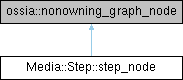
Detailed Description
Plays the steps of one of several sequences.
A step lasts duration seconds, or when synced a fraction of a whole note, so that it follows the tempo. Either way the steps are counted from the start of the process: its first step plays as it starts, wherever that falls on the bars. A sequence asked for on sequence_select starts at its first step at the next point of the switch_quantification grid (Patternist's convention: 0 is at once, 1 a bar, above 1 a fraction of a whole note).
Public Member Functions | |
| std::string | label () const noexcept override |
| void | request_sequence (int idx) noexcept |
| void | set_duration (const ossia::value &v) noexcept |
| A plain number is seconds; {value, mode}: mode 0 seconds, else synced. | |
| void | read_controls () noexcept |
| void | run (const ossia::token_request &tk, ossia::exec_state_facade st) noexcept override |
| double | step_quarters (const ossia::token_request &tk) const noexcept |
| void | follow_jump (const ossia::token_request &tk) noexcept |
| void | play_steps (const ossia::token_request &tk, double ratio, int64_t tick_start, bool rewinding, int64_t from, int64_t to) noexcept |
| Plays the steps whose sample falls in [from; to[. | |
| void | play_step (int64_t sample, bool rewinding) noexcept |
Public Attributes | |
| ossia::value_inlet | sequence_select |
| ossia::value_inlet | switch_quantification |
| ossia::value_inlet | duration |
| ossia::value_outlet | out |
| std::vector< ossia::float_vector > | sequences |
| int | current_sequence {} |
| int | pending_sequence {-1} |
| Sequence the next quantification point switches to; -1 when none waits. | |
| double | switch_rate {1.} |
| double | step_duration {0.0625} |
| Seconds, or a fraction of a whole note when synced. | |
| bool | synced {true} |
| int | current {} |
| The step that plays next. | |
| std::atomic_int | last {-1} |
| The step that played last; read by the UI thread. | |
| double | origin {} |
| int64_t | next_date {std::numeric_limits<int64_t>::min()} |
| Where the next tick starts if time goes on; anything else is a jump. | |
Member Function Documentation
◆ follow_jump()
|
inlinenoexcept |
The process started, or the transport moved it: count the steps from its start again, and play on from the step the position falls in.
◆ step_quarters()
|
inlinenoexcept |
Length of a synced step, in quarter notes: as the quantification grid, a bar or more counts in bars.
Member Data Documentation
◆ origin
| double Media::Step::step_node::origin {} |
Musical position, in quarter notes, of the start of the process: synced steps are counted from it.
◆ sequences
| std::vector<ossia::float_vector> Media::Step::step_node::sequences |
The values to send, already mapped to [min; max]. The whole list, so that a switch moves an index rather than copying, on the audio thread.
The documentation for this class was generated from the following file: